


In any good preparation, the first thing to do is to break down the test mercilessly. The official syllabus is not a guideline; instead, it is a contract. For popular RRB exams such as NTPC, the process entails multi-level examination (Prelims and Mains), followed by Skill Test/Aptitude Test and Document Verification. CBTs are your first filters, and their structure will determine how you approach a study plan.
The shared weight in both the CBTs shows unequivocally where the high-stakes content is. For example, in CBT-2 GA has the maximum weightage and becomes a scoring section. The Mathematics and General Intelligence & Reasoning sections are close behind. This distribution of marks ought simply to mean the apportioning of your study time. You have to give more hours to the portion where you would get highest return on your investment and at the same time 100% coverage should be there as far as syllabus is concern. A disciplined candidate has learned to respect the negative marking typically a pace of 1/3 for each wrong answer/note that we start talking about maintaining a higher amount of accuracy in addition to speed, when all your focus is on simply attempting everything.
From experience working with Railway aspirants, the biggest shift needed for railway exam preparation 2025 is moving away from random study toward syllabus-first planning. Many candidates start solving questions without clearly mapping the latest RRB syllabus, which leads to uneven preparation. A smarter approach is to first break the syllabus into sections—Maths, Reasoning, and General Awareness—then assign weekly targets. For GA, focus on high-scoring topics like current affairs (last 8–10 months), static GK linked to railways, and basic science. This matters because GA is often the deciding section when scores are close, as seen repeatedly in exams conducted by the Railway Recruitment Board.
Another area where students struggle is puzzle-solving in reasoning. From what I’ve observed, the mistake isn’t lack of ability but lack of a fixed method. Choose one clear strategy for each puzzle type—seating, syllogism, or inequality—and practice it consistently under time limits. Avoid learning too many “short tricks” at once; they increase confusion during the exam. For RRB exam preparation tips syllabus 2025, accuracy with calm execution beats speed without control. If your routine feels repeatable and stress-free, you’re likely on the right path.
The search for a Sarkari position requires dedication and timely information.
📌 Don’t Miss Out on the Upcoming Railway Job Alerts!
🔍 Stay ahead with daily updates on RRB, Apprentice, Group D & more!
👉 📢 Check Upcoming Railway Naukri 2025 →
The Mathematics and Reasoning Battleground
Math’s: The mathematics section is a raw test of your basic calculative speed and fundamental clarity. These such areas like Number Systems, Mensuration, Profit & Loss or Simple and Compound Interest often tend to be highly weighted topics. The \”no bull\” way to Math is simply practice until the steps become reflex. You need to get beyond that point where you are just struggling to remember some formula, and instead be at the place where those formulas come automatically when you are under stress. Practice daily, timing your practice. Don’t just solve a question; solve adjacent to an even tighter timeframe than the actual exam. Keep a one-paged formula sheet per chapter updated and reviewed every day.
Likewise, GI-Reasoning is not a quotient of natural cleverness; but the knack of watching for compounded simulations. Analogies, Syllogism, Coding-Decoding and Puzzles are the basics. For the puzzles and analytic reasoning, which becomes quite involved in later CBT stages, there are no shortcuts to mastery but practice with a variety of models. Begin with simple examples to understand the concept and then move on – right away – to PYQs or previous years\’ questions (PYQs) to get a feel for railway exams difficulty curve. For this section, practice is the only real theory. You need to work on decoding the hint faster, doing tunnels from series on coding/series puzzle.
You can find your Sarkari result easily online after the exam.
Mastering the General Awareness Fortress
Static GK: The Unchanging Core
It is the GA section that most aspirants stumble upon, and that is solely due to an extensive syllabus. This section can be divided in two proven ways: Static GK and Current Affairs. Static GK is the other reality based which remains—past events, land forms (river/mountain/plateau plain …), constitutional articles, and headquarters of world organizations. The \”no bull\” approach to Static GK is organized, themed memorization and then constant retrieval practice. Instead of learning history chronologically, learn it thematically: all freedom struggles together, all the major dynasties together or a discussion starting with Greece and Rome and working down to the present.
The creation and use of mnemonics and brief notes that resonate with you is a must-have here. You have to summaries huge amounts of information into flashcards or diagrammatic summaries. Link or associate Static GK topics with Current Affairs as much as you can. If a recent event is about the projects lining up on Mahanadi, for instance, it would make sense to relook all water facts around Mahanadi (including Hirakud, because you can’t leave it beyond your radar now) as soon as possible. This is a form of associative learning that improves recall under the pressure of exams.
Many applicants rely on a free job alert service to track new openings instantly. r
Current Affairs: The Dynamic Challenge
You cannot run away from what Current Affairs (CA) needs 1. What’s needed? The standard window is the last six to twelve months before the examination date. Just passively reading the newspaper is not sufficient; you need to be a clever information collector. Pay close attention to national and international current affairs, government flagship programmes, science and technology development in recent years (particularly in space and Defence) big awards, major sports.
The best practice is to rely on a consolidated monthly PDF and monitor the capsules of daily news current affairs from credible sources. You need to be passive with your revision and attack it (read through 10-15 pages of notes once a week over the course of an entire weekend, for example) every week and all you’ve studied in a month at the end. In railway exams, the CA questions are mostly based on facts— who, what, when, where — and not so much analytical in nature. For that reason, your study should focus on the name, date and place of origin and purpose of new initiatives. There is nothing else that will determine success as a student here other than consistency!
This valuable tool ensures you never miss a deadline for that crucial Sarkari exam.
Securing a government post offers stability and a fulfilling career. You need consistent free job alerts sent straight to your phone or email.
The Tactical Map: Time, Resources
The Unwavering Study Timetable
The only effective study plan for a high-stakes exam will be one that is actually realistic and sustainable, not just aspirational. A successful schedule is based on three fundamental principles: consistency, prioritization and flexibility.
Schedule a certain number of hours that you work every day, maybe six to eight hours, and stick strictly to this schedule. Make sure to prioritize your time – Hone in the morning when brain is fresh to study rather tougher or bigger weighted subjects like Math’s and Hard reasoning. Keep the post lunch and evening slots for lighter, revision-heavy subjects like General Awareness. Make sure to use the Pomodoro Technique – intense studying for 25-50 minutes followed by a short 5-10 minute pause – to keep your focus and avoid mental exhaustion. Your schedule also has to have a provision for daily PYPs practice and weekly Full syllabus Mock Tests.
These notifications cover every new job alert from various departments.
Resource Selection and the Power of PYQs
The deadly error most candidates make is hoarding resources — they amass a dozen of books and online courses but do not get through any. Keep it minimal: You don’t need to study from multiple books for each subject, try to stick to 1-2 good ones (a general conceptual one and a consolidated GK) at best. Repeated focus on the limited and high quality is exponentially more effective than haphazard reading of the many.
But the Previous Year Question Papers are the precious materials. PYQs are not for practice but diagnostics because by solving them one can find the areas in which he/she is lacking or need more practice. They show the exact language, difficulty level and common themes of the examining body. Solve as many PYQs from any other RRB exams you can; treat them like full mock tests just to get used to the pattern and pressure of examination.
We help you stay ahead of the competition every single day.
Mock Tests: Your Diagnostic Weapon
The Mock Test is your war game, and you should take it dead seriously. Take at least one full-length practice test each week, in conditions as close to the actual test setting as possible: no phone, no distractions and under the exact time constraints.
But in reality, the preparation starts after taking the test, i.e. Post mortem analysis. This is the point of no return between success and hope. For each practice test, you should:
- Seek out Weaknesses: Write down what topics you made errors in or for which you spent too much time on.
- Analyze Mistakes: Separate what were silly mistakes (silly calculation, misreading the question) from conceptual mistakes (not knowing the idea below).
- Targeted Fix: Given the conceptual misunderstandings, go back to the corresponding chapter/section in your CCOC and do additional practice problems until you have demonstrated mastery.
If you get 70% on a mock, it\’s not ready for high-fives; the point is to ruthlessly identify and repair the 30%. 1 This singular focus on closing the performance gap is THE route to a high score.
Look for a free jobalert right now and begin your journey.
📑 Missed a Notification? Get All Govt Job Alerts in Your Phone!
🧾 Get access to all job notices, PDF ads & deadlines in one archive.
👉 📱 Get All Sarkari Job Notifications →
The Psychological game- mindset & Resilience
Overcoming Psychological Barriers
Preparing from a competitive exam is as much of a brain storming challenge as reading college books. Second guessing and comparison syndrome are easy traps. You\’ve got to mercilessly eliminate self-defeating negative mantras as \”I\’m no good at Math\” and supplant them with growth-spurring assertions, e.g., \”I am steadily getting faster in Arithmetic. The process requires a growth mindset, the belief that your skills can be developed through practice and perseverance.
Another major psychological barrier is being afraid of failure (which often results in procrastination or burnout). Counteract this by zooming in on the process, not just the outcome. Frame day-level, measurable process goals (e.g. “Solve 50 Math questions and revise three Static GK topics”) as opposed to intangible result goals (e.g., “Score 95 in the next mock). Praise the sustained effort, not just rising scores.
The Imperative of Holistic Well-being
Your brain is a high performance machine, and you can’t run it properly on stress and sleep deprivation. Good and continuous sleep is very important to allow the brain to consolidate new memories and information, which makes you remember things more efficiently when taking an examination. Don’t think of working out or taking short, refreshing breaks as’ wasting time; they are key to productivity. The stress hormone levels are kept in check by regular exercise such as a 30-minute walk, and so is better concentration. Eat well and stay hydrated Your physical health is related to your brain with you, the right kind of food sharpening memory. Accurate updates on vacancies across India are vital for success. Good luck with your next job alert and your future government career.
Successful Indian Railway exam is not a chance but a result of challenging and relentless attempts on your preparation. Then commit to deep conceptual comprehension, high-volume timed practice, thorough review of your performance on mock tests, and a no-nonsense mental approach. Forget looking for shortcuts; welcome the grind. This down-to-earth, no-nonsense method will turn overwhelm into an easy road to success.
Remember to follow every single free job alert religiously.
🎓 प्रैक्टिस सेट, मॉक टेस्ट और अध्ययन सामग्री देखना चाहते हैं!
✅ Railway Exam Study Material eligible and Download RRB Previous Year Papers.
👉 🎓 Get RRB Previous Year Papers →
FAQS
1. How should I begin RRB exam preparation?
Start by understanding the full syllabus and exam pattern. Allocate time based on weightage, practice Maths–Reasoning daily, revise GA weekly, and take regular mock tests to build speed and accuracy.
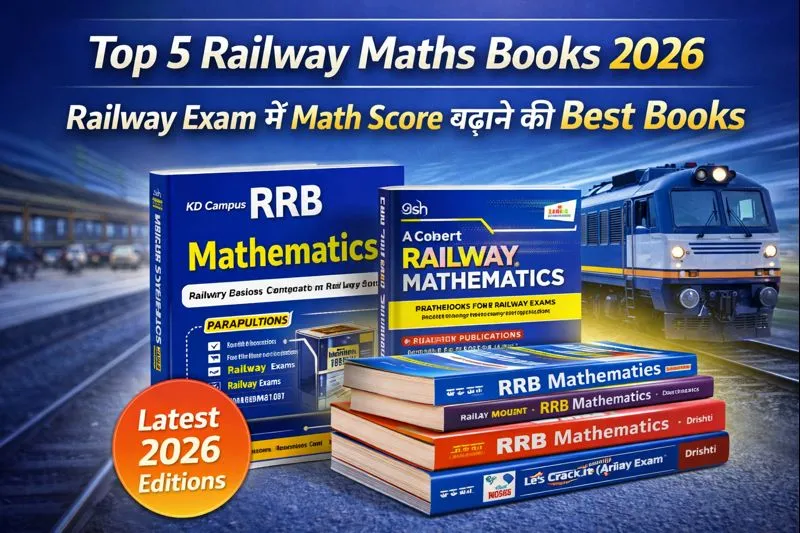
2. What are the best books for RRB exam preparation?
Use minimal but high-quality books: R.S. Aggarwal for Maths, Verbal & Non-Verbal Reasoning for GI, and monthly Current Affairs PDFs plus compact Static GK notes for General Awareness.
3. Why is GA difficult in RRB exam preparation?
Because GA covers a vast syllabus. Break it into Static GK and Current Affairs, use monthly PDFs, and apply associative linking—connecting news with static topics—to improve long-term retention.
4. How important are mock tests in RRB exam preparation?
Mock tests simulate the real exam. Weekly full mocks and daily sectional tests help you manage time, improve accuracy, and identify weak areas. The real improvement happens during post-test analysis.
5. How to maintain a strong mindset during RRB exam preparation?
Avoid comparison, focus on daily process goals, take timely breaks, sleep well, and ensure regular physical activity. A calm, disciplined mindset multiplies your overall performance.


Leave a Comment