

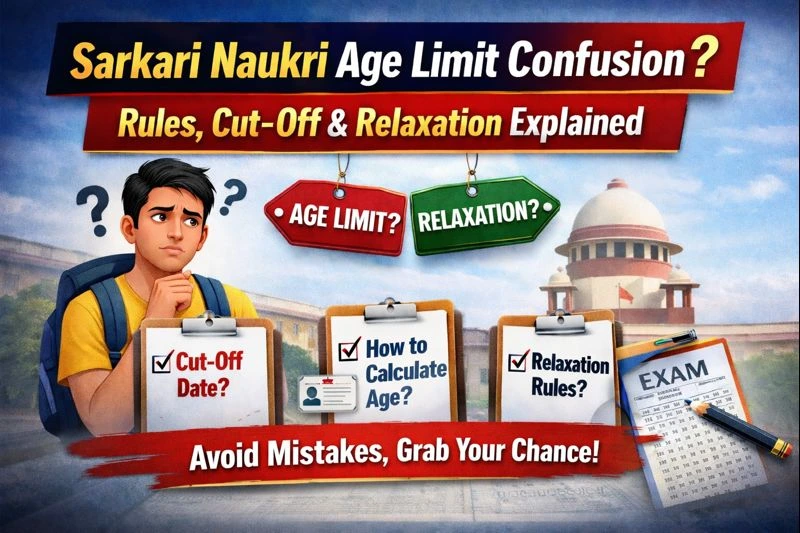
If you are preparing for Indian government jobs and often feel confused about age limits, cut-off dates, or relaxation rules, this is for you.
I’ve written this for beginners and intermediate aspirants—especially those who have missed or almost missed opportunities because of unclear age rules.
I’ve seen this confusion repeatedly: smart candidates preparing well, but losing chances due to one misunderstood age condition. This article exists to prevent that.
The real problem with age limits (from experience)
From what I’ve seen over the years, age limit confusion happens for three reasons:
-
Notifications use legal-style language
-
Age eligibility depends on multiple variables, not just your date of birth
-
Aspirants rely on assumptions, not verification
Most people think:
“If I’m 27 years old, I’m eligible.”
That’s rarely how government exams work.
Step 1: Understand what “Age Limit” actually means
In government job notifications, age limit is never calculated on today’s date.
It is always calculated based on a specific cut-off date mentioned in the notification.
Example:
“Candidate must be between 18 and 32 years as on 1st August 2026.”
This means:
-
Your age on 1 August 2026 matters
-
Your current age today does not matter
Why this matters
I’ve seen candidates disqualify themselves mentally even before checking the cut-off date—only to realize later they were actually eligible.
Step 2: Learn the three age numbers that matter
Every govt job age rule has three parts:
-
Minimum age
-
Maximum age
-
Cut-off date
Simple rule I always follow:
Calculate your age only on the cut-off date mentioned — nothing else.
If you don’t calculate it yourself, don’t trust assumptions.
Step 3: Age relaxation is not automatic — it’s conditional
This is where most mistakes happen.
Age relaxation depends on:
-
Category (SC/ST/OBC/EWS)
-
Special status (PwBD, Ex-servicemen)
-
Type of exam (central vs state)
-
Whether attempts are capped
Common misunderstanding:
“I’m OBC, so I automatically get 3 years relaxation.”
Not always.
Some exams:
-
Give relaxation only if reservation is applied
-
Don’t allow OBC relaxation in general posts
-
Exclude creamy layer candidates
Always read:
“Upper age limit relaxable for…”
Every word there matters.
Step 4: Attempts vs Age — they are different things
Many aspirants confuse attempt limits with age limits.
-
Age limit → decides whether you can apply
-
Attempts → decides how many times you can appear
You can:
-
Be within age but out of attempts
-
Have attempts left but cross age limit
Real-life mistake I’ve seen:
A candidate stopped applying after 3 attempts, thinking age relaxation was over — but attempts and age were unrelated in that exam.
Step 5: The “born on” confusion (very common)
Notifications often say:
“Candidates must have been born not earlier than… and not later than…”
This confuses many people.
Safe interpretation rule:
-
“Not earlier than” → birthday must be on or after
-
“Not later than” → birthday must be on or before
If your DOB is exactly on the boundary date, you are usually eligible — but always double-check examples given in the notice.
Practical checklist (save this before applying)
Before clicking Apply, I personally check:
-
Cut-off date mentioned clearly
-
My exact age on that cut-off date
-
Category relaxation rules (if any)
-
Whether relaxation applies to the post I’m choosing
-
Attempts vs age rules (both checked)
-
Any special clauses in footnotes or annexures
This checklist has saved me and others from costly mistakes.
Common real-world mistakes (and how to fix them)
Mistake 1: Trusting coaching posters or YouTube titles
Fix: Always verify with the official notification PDF.
Mistake 2: Assuming all govt exams have similar age rules
Fix: Treat every exam as unique.
Mistake 3: Ignoring state-specific rules
Fix: State jobs often have different cut-off dates and relaxations.
Mistake 4: Applying without calculating age yourself
Fix: Do the math manually once. It takes 2 minutes.
A simple age-calculation workflow I recommend
-
Note your DOB
-
Note the cut-off date
-
Calculate completed years as on cut-off
-
Add relaxation only if clearly allowed
-
Re-check using examples in the notification
If even one line feels unclear — pause and re-read.
Final takeaway
Age limit confusion is not about intelligence — it’s about attention to detail.
From experience, most rejections happen not because candidates are over-aged, but because they:
-
Didn’t calculate correctly
-
Misread relaxation rules
-
Assumed instead of verifying
If you learn to decode age limits once, it becomes easy forever.
FAQs (Based on real aspirant doubts)
1. If I cross the age limit by one day, am I eligible?
Usually no. Age limits are strict unless relaxation is explicitly allowed.
2. Does age relaxation apply to general posts for reserved candidates?
Not always. Depends on the exam and vacancy type.
3. Are age limits same every year for the same exam?
No. Cut-off dates and limits can change year to year.
4. Is DOB from Aadhaar or 10th certificate considered?
Usually 10th certificate — notification will specify.
5. Can I apply first and clarify age later?
Risky. Many applications are rejected during document verification.
6. Do private coaching sites give reliable age info?
Use them only as a reference, never as final authority.
7. Is there any flexibility during final selection?
Very rarely. Government rules leave little room for adjustment.
Leave a Comment